How to Calculate Your Bijli Bill in Pakistan?
The electricity bill is one of the biggest monthly expenses for a family in Pakistan, and it is also one of the hardest to understand. The bill shows units, slabs, fixed charges, fuel adjustment, taxes and surcharges, and the total can jump sharply when you cross from one slab to the next. A family that uses 190 units can pay far less per unit than a family that uses 210 units, even though they used almost the same electricity.
This guide explains how a bijli bill is calculated step by step: how units are counted, how the slab rates work, and what the extra charges mean. It uses the common domestic tariff structure as an estimate, with real examples, so you can check your own bill and see where you can save. The free Bijli Bill Calculator on this site does the same calculation in seconds, with no signup and no login.
What Is the Bijli Bill Calculator?
A unit is one kilowatt-hour, written as kWh. If you run a 1,000 watt heater for one hour, you use 1 unit. A 100 watt bulb running for 10 hours also uses 1 unit. Your meter counts the units you use in the month, and the bill charges you for them slab by slab. The first units are cheap, and the later units are expensive, so using more electricity costs more per unit, not the same amount.
On top of the units, the bill adds a fixed charge, a fuel price adjustment that changes every month, and taxes such as GST and sometimes income tax. These extras can add 20 to 30 percent to the bill, which is why the total is much higher than the units multiplied by one rate. The bill also shows your meter reading, the previous reading, and the dates, so you can check that the units are correct.
The Bijli Bill Method
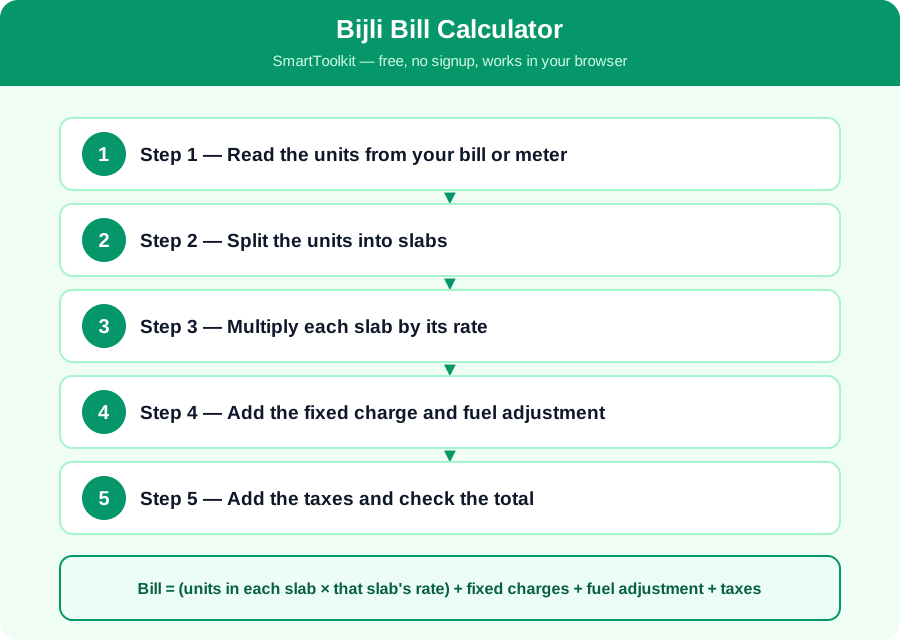
Bill = (units in each slab × that slab's rate) + fixed charges + fuel adjustment + taxes
First split your units into the slabs. For example, the first 100 units might be charged at Rs 10 per unit, the next 100 at Rs 15, and the rest at Rs 25. Then multiply the units in each slab by that slab's rate and add the results. Then add the fixed charge, the fuel price adjustment for the month, and the taxes. The sum is your total bill. The slab rates in this guide are an estimate based on the common domestic tariff, so always check the rates printed on your own bill.
The slab jump is the part that surprises most people. If you use 200 units, all 200 are not charged at the highest rate — only the units above 100 are. But if you cross into a higher slab, the rate for the extra units is much higher, so even 10 extra units can add hundreds of rupees. That is why switching off one air conditioner for a few hours a day can save a lot.
How to Use the Bijli Bill Calculator — Step by Step
Follow these five steps one by one. Each step builds on the last one, so do them in order and check your answer at the end.
Step 1 — Read the units from your bill or meter
Find the current reading and the previous reading on your bill, and subtract them to get the units used. If the bill says the current reading is 5,200 and the previous reading was 5,000, you used 200 units. If you read the meter yourself, write both readings down and check them twice.
Step 2 — Split the units into slabs
Fill the slabs from the bottom. For 200 units, the first 100 go in the cheapest slab, and the next 100 go in the next slab. Write the units in each slab down separately, because each slab has its own rate, and mixing them up is the most common mistake.
Step 3 — Multiply each slab by its rate
Work out the cost of each slab. If the first 100 units are Rs 10 each, that is Rs 1,000. If the next 100 are Rs 15 each, that is Rs 1,500. Add them together: the energy charge is Rs 2,500. This is the main part of the bill, before the extra charges.
Step 4 — Add the fixed charge and fuel adjustment
Add the fixed monthly charge printed on your bill, and the fuel price adjustment for that month. The fuel adjustment changes every month with the price of fuel, so it is different on every bill. Add both to the energy charge from Step 3.
Step 5 — Add the taxes and check the total
Add GST and any other taxes shown on the bill, usually as a percentage of the amount so far. The result is your total bill. Compare it with the total printed on your bill. If they are close, your bill is correct. If they are far apart, check the units and the slab rates first, and then call your electricity company.
Worked Example
A family in Lahore uses 300 units in a month. The first 100 units are charged at Rs 10, which is Rs 1,000. The next 100 units are charged at Rs 15, which is Rs 1,500. The last 100 units are charged at Rs 25, which is Rs 2,500. The energy charge is Rs 5,000. The fixed charge is Rs 500 and the fuel adjustment is Rs 600, which brings the total to Rs 6,100. GST at 18 percent is about Rs 1,100, so the final bill is about Rs 7,200. If the same family had used only 190 units, the energy charge would be about Rs 2,350 and the final bill would be about Rs 3,900 — saving just 110 units would cut the bill almost in half, because the expensive top slab is avoided.
Common Mistakes to Avoid
Mistake: Charging all units at the highest rate. Only the units in the top slab are charged at that rate, so multiplying all 300 units by Rs 25 gives Rs 7,500, which is far more than the real energy charge of Rs 5,000.
Mistake: Forgetting the fixed charge and taxes. The units alone are only part of the bill, and the extras can add 20 to 30 percent, so a bill worked out from units alone will always look too low.
Mistake: Using last month's fuel adjustment. The fuel price adjustment changes every month, so use the figure printed on the current bill, not last month's bill.
Mistake: Not checking the meter reading. A wrong reading, or an estimated reading when the meter reader could not reach your meter, can add hundreds of units to your bill, so always compare the reading on the bill with your own meter.
Frequently Asked Questions
What is a unit of electricity? One unit is one kilowatt-hour. A 1,000 watt appliance running for one hour uses 1 unit, a 100 watt bulb running for 10 hours uses 1 unit, and a 200 watt fan running for 5 hours uses 1 unit.
Why does my bill jump so much when I use a little more? Because of the slabs. Once you cross into a higher slab, the extra units are charged at a much higher rate, so even a small increase in use can add a large amount to the bill.
What is the fuel price adjustment? It is a monthly charge that covers changes in the price of fuel used to generate electricity. It goes up when fuel prices rise and down when they fall, and it is shown as a separate line on your bill.
How can I reduce my bijli bill? Use fans instead of air conditioners when you can, switch off lights in empty rooms, use energy-saving bulbs, and avoid running heavy appliances at the same time. The biggest saving comes from staying in a lower slab.
Why Use SmartToolkit for This?
You now know how units are counted, how the slabs work, and what the extra charges on your bill mean. Read your meter every month, check the bill against this method, and watch which slab you are in — staying below the expensive slab is the easiest way to save. Use the free Bijli Bill Calculator on this site to estimate any bill in seconds — it works in your browser, needs no signup and no login, and your readings never leave your device.
Use the Bijli Bill Calculator — free, no signup, no login, and your data never leaves your browser.