How to Calculate BMI? Formula, Chart and Healthy Range
BMI means Body Mass Index. It is a simple number that compares your weight with your height, and doctors use it as a quick first check for whether your weight is in a healthy range. In Pakistan and India, where diabetes and heart disease are common, knowing your BMI is a useful early warning. It takes one minute to work out, and it needs no blood test and no clinic visit.
This guide explains the BMI formula, shows you how to calculate it step by step, and explains what the result means for adults, for children and for athletes. You will also learn why BMI is only a first check and not a full health test, and what to do if your result is outside the healthy range. The free BMI Calculator on this site gives you the same answer instantly, with no signup and no login.
What Is the BMI Calculator?
BMI is your weight in kilograms divided by your height in metres, multiplied by itself. The result is a single number, and that number is placed on a scale. Below 18.5 is underweight, 18.5 to 24.9 is healthy, 25 to 29.9 is overweight, and 30 or above is obese. The scale is the same for men and women, and it was designed for adults, not for children.
BMI is useful because it is fast and it works for most people, but it has limits. It cannot tell muscle from fat, so a bodybuilder can have a high BMI and still be healthy. It also does not measure where the fat is stored, and belly fat is more dangerous than fat on the hips. Use BMI as a starting point, and if the result worries you, talk to a doctor rather than starting a crash diet.
The BMI Formula
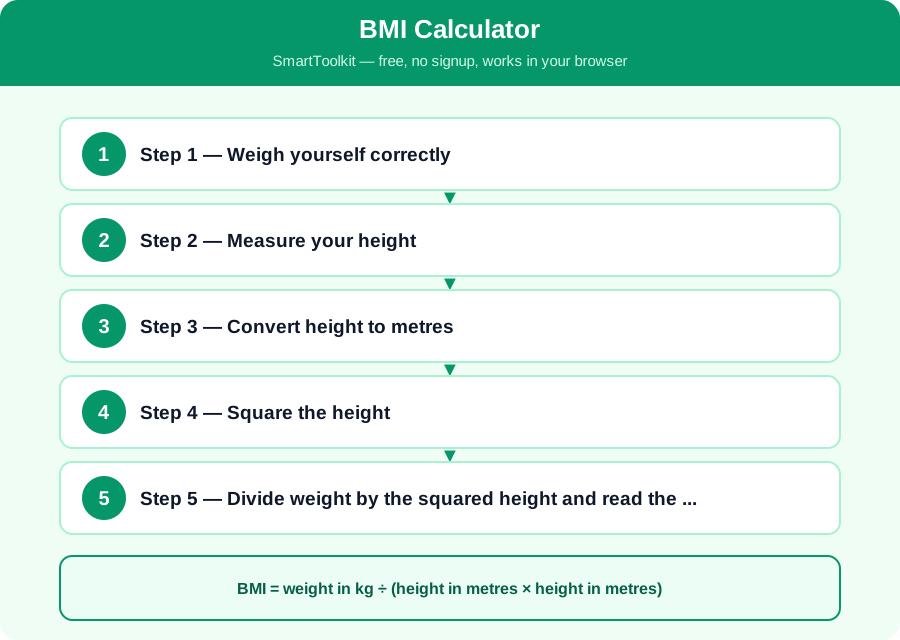
BMI = weight in kg ÷ (height in metres × height in metres)
First convert your height to metres. A height of 170 cm is 1.70 metres. Then multiply the height by itself: 1.70 times 1.70 is 2.89. Then divide your weight by that number. For a weight of 70 kg, that is 70 divided by 2.89, which is about 24.2. That result is in the healthy range, just below the overweight line of 25.
If your height is in feet and inches, convert it first. One foot is 30.48 cm and one inch is 2.54 cm. A height of 5 feet 7 inches is 170 cm, or 1.70 metres. Never put feet directly into the formula, because the answer will be completely wrong. Our calculator lets you enter feet and inches and converts them for you.
How to Use the BMI Calculator — Step by Step
Follow these five steps one by one. Each step builds on the last one, so do them in order and check your answer at the end.
Step 1 — Weigh yourself correctly
Weigh yourself in the morning, after using the toilet and before eating, wearing light clothes and no shoes. Use the same scale each time, on a hard flat floor. Your weight can change by 1 or 2 kg during the day because of food and water, so a morning weight is the most honest one.
Step 2 — Measure your height
Stand straight against a wall with no shoes, heels together, and look straight ahead. Mark the top of your head and measure from the floor to the mark in centimetres. Ask someone to help you, because measuring yourself usually adds a centimetre or two by mistake.
Step 3 — Convert height to metres
Divide your height in centimetres by 100. A height of 165 cm becomes 1.65 metres. Write the number down with two decimal places, because a small error in height changes the BMI more than the same error in weight does.
Step 4 — Square the height
Multiply your height in metres by itself. For 1.70 metres that is 1.70 times 1.70, which is 2.89. Keep two decimal places. This is the number you will divide your weight by, so write it down clearly before the next step.
Step 5 — Divide weight by the squared height and read the scale
Divide your weight in kilograms by the number from Step 4. For 70 kg and 2.89, the answer is about 24.2. Compare it with the scale: under 18.5 underweight, 18.5 to 24.9 healthy, 25 to 29.9 overweight, 30 or above obese. Check the same answer with the free BMI Calculator on this site.
Worked Example
Ahmed is 175 cm tall and weighs 85 kg. His height in metres is 1.75, and 1.75 times 1.75 is 3.06. Dividing 85 by 3.06 gives a BMI of about 27.8, which is in the overweight range. To reach the top of the healthy range, which is a BMI of 24.9, his weight would need to be 24.9 times 3.06, which is about 76 kg. That means losing about 9 kg would bring him into the healthy range. Losing half a kilo to one kilo per week is a safe speed, so this would take about two to four months of steady eating and walking.
Common Mistakes to Avoid
Mistake: Measuring height with shoes on. Shoes add 2 to 3 cm, which lowers your BMI and can hide an overweight result, so always measure barefoot.
Mistake: Using your weight after a big meal. Food and water can add 1 to 2 kg, so weigh yourself in the morning for a fair result.
Mistake: Using BMI for children with the adult scale. Children are judged against growth charts for their age, not against the adult ranges, so a child's BMI number means something different.
Mistake: Treating BMI as a full health test. BMI does not measure blood pressure, blood sugar, cholesterol or fitness, so a healthy BMI does not guarantee good health, and a high BMI does not always mean you are unhealthy.
Frequently Asked Questions
What is a healthy BMI? For most adults, a BMI between 18.5 and 24.9 is healthy. Below 18.5 is underweight and 25 or above is overweight. Some Asian health guidelines use a lower overweight line of 23, because diabetes risk rises earlier, so ask your doctor which scale fits you.
Is BMI accurate for athletes? Not always. Muscle weighs more than fat, so a muscular person can have a BMI over 25 while having very little body fat. Athletes should also check waist size and body fat percentage, not BMI alone.
How often should I check my BMI? Once a month is enough. Weight changes slowly, and checking every day only shows water changes. Weigh yourself on the same day each month, at the same time, and write the result down.
Can BMI tell me how much weight to lose? It can give you a target range. Multiply your squared height by 24.9 to get the top of the healthy weight range, and subtract that from your current weight. That is a sensible first target, but a doctor can set a personal target for you.
Why Use SmartToolkit for This?
You now know how BMI is calculated, what the ranges mean, and where it can mislead you. Check your BMI once a month, and if the result is outside the healthy range, make small steady changes to food and walking rather than a crash diet. Use the free BMI Calculator on this site for a quick check — it works in your browser, needs no signup and no login, and your weight and height never leave your device.
Use the BMI Calculator — free, no signup, no login, and your data never leaves your browser.