How to Calculate Compound Interest? Formula and Examples
Compound interest is often called the eighth wonder of the world, because it makes money grow faster the longer you leave it. If you save Rs 100,000 at 10 percent, simple interest gives you Rs 10,000 every year. Compound interest also gives you Rs 10,000 in the first year, but in the second year you earn interest on Rs 110,000, so you get Rs 11,000, and the amount keeps growing. Over ten or twenty years, the difference is enormous.
This guide explains compound interest in plain words, the formula, and how to calculate it step by step with real examples from Pakistan. You will see why starting early matters more than saving a large amount late, and how monthly savings grow over time. The free Compound Interest Calculator on this site does the same calculation in seconds, with no signup and no login.
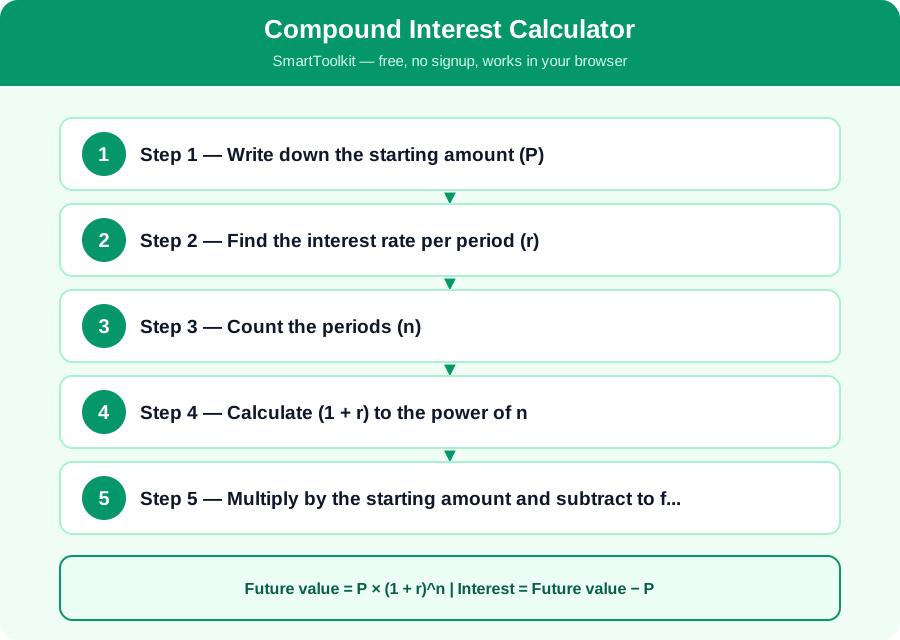
What Is the Compound Interest Calculator?
Compound interest is interest earned on both the original money and the interest already earned. Simple interest only pays on the original amount, so it grows in a straight line. Compound interest pays on a growing amount, so it grows in a curve that gets steeper every year. The more often the interest is added — every year, every month or every day — the faster the money grows.
In Pakistan, savings accounts, fixed deposits, National Savings schemes and mutual funds all use compound interest in some form, though the rate and the compounding period are different. A fixed deposit that compounds every year grows faster than one that pays simple interest, even at the same rate. Always ask how often the interest is compounded before you compare two savings options, because the compounding period changes the result.
The Compound Interest Formula
Future value = P × (1 + r)^n | Interest = Future value − P
In this formula P is the money you start with, r is the interest rate per period as a decimal, and n is the number of periods. For Rs 100,000 at 10 percent per year for 3 years, r is 0.10 and n is 3. The future value is 100,000 times 1.10 to the power of 3, which is 100,000 times 1.331, or Rs 133,100. The interest earned is Rs 33,100, while simple interest would have given only Rs 30,000.
The rate and the periods must match. If interest is compounded monthly, divide the yearly rate by 12 and multiply the years by 12. For 12 percent a year compounded monthly, the monthly rate is 1 percent and 5 years means 60 periods. Mixing a yearly rate with monthly periods is the most common mistake, and it makes the answer far too large.
How to Use the Compound Interest Calculator — Step by Step
Follow these five steps one by one. Each step builds on the last one, so do them in order and check your answer at the end.
Step 1 — Write down the starting amount (P)
This is the money you put in at the start, for example Rs 100,000 in a fixed deposit. Do not include money you plan to add later — that is handled separately, and adding it now will inflate the answer.
Step 2 — Find the interest rate per period (r)
Ask the bank for the yearly rate and how often it compounds. For 10 percent a year compounded yearly, r is 0.10. For 12 percent a year compounded monthly, the monthly rate is 12 divided by 12 divided by 100, which is 0.01. Write down both the rate and the compounding period.
Step 3 — Count the periods (n)
Multiply the number of years by the number of compounding periods in a year. For 5 years compounded yearly, n is 5. For 5 years compounded monthly, n is 60. This number is the power in the formula, so getting it wrong changes the answer completely.
Step 4 — Calculate (1 + r) to the power of n
Add 1 to the rate and raise it to the power of n. For 10 percent over 3 years, that is 1.10 to the power of 3, which is 1.331. You can do this on a calculator with the power button, or multiply 1.10 by itself three times: 1.10 times 1.10 is 1.21, and 1.21 times 1.10 is 1.331.
Step 5 — Multiply by the starting amount and subtract to find the interest
Multiply P by the number from Step 4. For Rs 100,000 times 1.331, the future value is Rs 133,100. Subtract the starting amount to find the interest: Rs 133,100 minus Rs 100,000 is Rs 33,100. Check the answer with the free Compound Interest Calculator on this site.
Worked Example
Sara invests Rs 200,000 at 12 percent a year, compounded yearly, for 10 years. The future value is 200,000 times 1.12 to the power of 10. 1.12 to the power of 10 is about 3.106, so the future value is about Rs 621,000, and the interest is about Rs 421,000 — more than double her original money. If she had waited 5 years and invested the same amount for only 5 years, the future value would be about Rs 352,000. Starting 5 years earlier nearly doubled her final amount, which is why financial advisers say time matters more than the amount you save.
Common Mistakes to Avoid
Mistake: Using simple interest by mistake. Simple interest on Rs 100,000 at 10 percent for 3 years is Rs 30,000, but compound interest is Rs 33,100, so using the wrong method understates the growth.
Mistake: Mixing yearly rates with monthly periods. A 12 percent yearly rate compounded monthly means a 1 percent monthly rate and 60 periods for 5 years, not a 12 percent rate for 60 periods.
Mistake: Forgetting tax and inflation. The interest you earn is taxed, and prices rise every year, so the real value of your savings grows more slowly than the headline number suggests.
Mistake: Withdrawing the interest every year. If you take the interest out, it cannot earn more interest, and the growth becomes simple interest. Leaving it in is what makes compounding work.
Frequently Asked Questions
What is the difference between compound and simple interest? Simple interest is only paid on the original amount, so it grows by the same amount every year. Compound interest is paid on the original amount plus the interest already earned, so it grows faster every year.
How long will my money take to double? Use the rule of 72: divide 72 by the yearly rate. At 12 percent, money doubles in about 6 years. At 8 percent, it takes about 9 years. This is an estimate, but it is close enough for planning.
Does compounding monthly make a big difference? Yes, but it is small at first and grows over time. On Rs 100,000 at 12 percent for 10 years, yearly compounding gives about Rs 310,000, while monthly compounding gives about Rs 330,000. The difference grows with the amount and the time.
Is compound interest allowed in Islamic banking? Islamic banks do not pay interest, but they do share profit, and the profit can compound in a similar way. The rules are different, so ask your bank how its profit-sharing product works before you invest.
Why Use SmartToolkit for This?
You now know how compound interest works, why time matters more than the amount, and how to calculate it step by step. The best time to start saving was years ago, and the second best time is today. Use the free Compound Interest Calculator on this site to plan your savings — it works in your browser, needs no signup and no login, and your amounts never leave your device.
Use the Compound Interest Calculator — free, no signup, no login, and your data never leaves your browser.