How to Calculate Discount? Sale Price Formula with Examples
Every shop in Pakistan runs a sale: 20 percent off, 50 percent off, buy one get one free. The big numbers on the poster look exciting, but the only number that matters is the price you actually pay. A 50 percent discount on an overpriced item can still be more expensive than the same item at full price in another shop. To shop wisely, you need to work out the sale price yourself, in seconds, before you pay.
This guide shows you how to calculate a discount step by step, how shops use double discounts, and how to compare two sales to find the real bargain. It uses real shop examples from Pakistan, so you can use the same method in a bazaar or a mall. The free Discount Calculator on this site does the same sum instantly, with no signup and no login.
What Is the Discount Calculator?
A discount is a reduction in price, usually given as a percentage of the original price. If a shirt costs Rs 2,000 and the discount is 25 percent, the shop takes Rs 500 off, and you pay Rs 1,500. The discount amount and the sale price are two different numbers, and mixing them up is the most common mistake. The discount is what you save, and the sale price is what you pay.
Shops use discounts to clear old stock, to bring in customers, and to compete with other shops. Some discounts are genuine, and some are not: a shop may raise the price first and then offer a big discount, so the sale price is the same as the normal price elsewhere. The only way to know is to work out the sale price and compare it with the price in two other shops before you buy.
The Discount Formulas
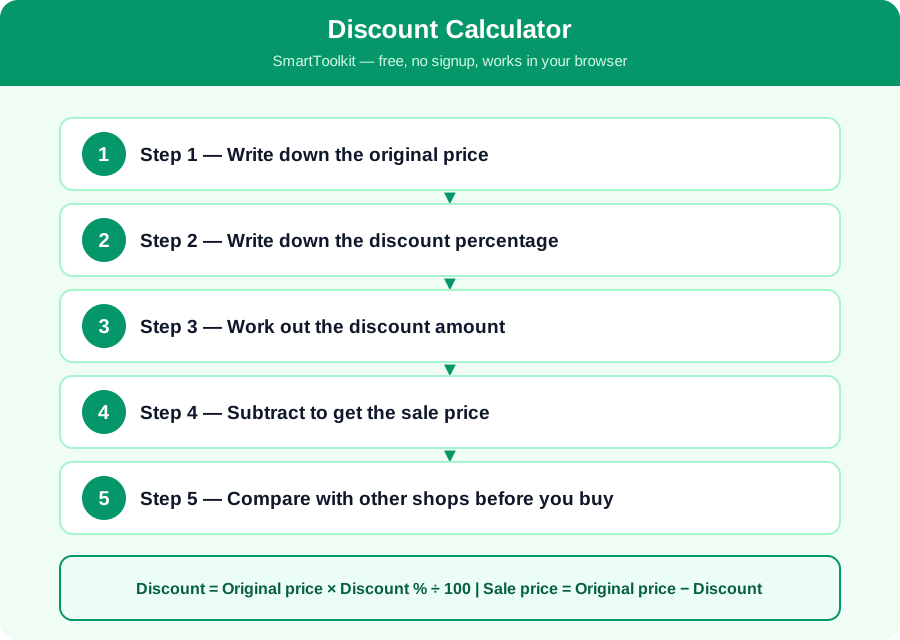
Discount = Original price × Discount % ÷ 100 | Sale price = Original price − Discount
First work out the discount amount: multiply the original price by the discount percentage and divide by 100. For Rs 2,000 at 25 percent, that is Rs 500. Then subtract the discount from the original price to get the sale price: Rs 2,000 minus Rs 500 is Rs 1,500. A quicker way is to pay 100 minus the discount percent — here 75 percent — of the original price, which is 0.75 times Rs 2,000, also Rs 1,500.
Double discounts do not add up. A 20 percent discount followed by a 10 percent discount is not 30 percent off, because the second discount is taken from the already reduced price. On Rs 1,000, the first discount takes off Rs 200 and leaves Rs 800, then 10 percent of Rs 800 is Rs 80, so the final price is Rs 720. That is a total discount of 28 percent, not 30 percent.
How to Use the Discount Calculator — Step by Step
Follow these five steps one by one. Each step builds on the last one, so do them in order and check your answer at the end.
Step 1 — Write down the original price
Find the price before the discount, on the tag or the shelf. For example, Rs 3,000 for a pair of shoes. If the tag only shows the sale price, you cannot work out the discount from it alone — you need the original price, so ask the shopkeeper or check the price in another shop.
Step 2 — Write down the discount percentage
Read the sale sign carefully: 20 percent off, 30 percent off, or flat Rs 500 off. A percentage discount and a flat discount are different, so do not mix them. If the sign says up to 50 percent off, the item you want may only be 10 percent off, so check the tag on your item.
Step 3 — Work out the discount amount
Multiply the original price by the discount percentage and divide by 100. For Rs 3,000 at 20 percent, that is 3,000 times 20 divided by 100, which is Rs 600. That is the money you save, and it is the number to check against the tag.
Step 4 — Subtract to get the sale price
Subtract the discount from the original price. Here that is Rs 3,000 minus Rs 600, which is Rs 2,400. That is what you should pay at the counter. If the shop charges more, show your calculation and ask why.
Step 5 — Compare with other shops before you buy
Check the same item in one or two other shops, or online, and work out their sale prices the same way. The biggest percentage is not always the cheapest price, because the original prices are different. Buy from the shop with the lowest sale price, not the biggest discount sign.
Worked Example
A jacket is priced at Rs 6,000 with 30 percent off. The discount is 30 percent of Rs 6,000, which is Rs 1,800, so the sale price is Rs 4,200. Another shop sells the same jacket for Rs 5,000 with 10 percent off: the discount is Rs 500 and the sale price is Rs 4,500. The first shop is cheaper, even though you might have expected the second shop to be better. Now take a double discount: a shirt at Rs 2,000 with 20 percent off, then 10 percent off at the counter. After the first discount the price is Rs 1,600, and 10 percent of that is Rs 160, so the final price is Rs 1,440 — a total saving of Rs 560, not Rs 600.
Common Mistakes to Avoid
Mistake: Adding two discounts together. A 20 percent discount plus a 10 percent discount is 28 percent in total, not 30 percent, because the second discount applies to the reduced price.
Mistake: Forgetting that the discount is on the original price. If you work out 20 percent of the sale price instead of the original price, the discount comes out too small and the sale price comes out too high.
Mistake: Trusting the sale sign without checking. Some shops raise the price before a sale, so always compare the sale price with the normal price in another shop.
Mistake: Ignoring extra charges. Delivery charges, card surcharges and taxes can eat the whole discount, so work out the total you will actually pay, not just the sale price on the tag.
Frequently Asked Questions
How do I calculate 40 percent off quickly? Find 10 percent by moving the decimal one place left, then multiply by 4. For Rs 2,500, 10 percent is Rs 250, so 40 percent is Rs 1,000, and the sale price is Rs 1,500.
What is the difference between discount and sale price? The discount is the money you save, and the sale price is the money you pay. On a Rs 2,000 item with 25 percent off, the discount is Rs 500 and the sale price is Rs 1,500. Never confuse the two.
Is buy one get one free the same as 50 percent off? Only if both items cost the same. If you buy one item for Rs 1,000 and get a Rs 600 item free, you paid Rs 1,000 for Rs 1,600 of goods, which is a discount of 37.5 percent, not 50 percent.
How do I find the original price from a sale price? Divide the sale price by 1 minus the discount as a decimal. If you paid Rs 1,500 after a 25 percent discount, divide by 0.75 to get the original price of Rs 2,000.
Why Use SmartToolkit for This?
You now know how to work out any discount, how double discounts really work, and how to compare sales to find the true bargain. The biggest sign in the shop is not always the best deal, so calculate the sale price before you pay. Use the free Discount Calculator on this site for a fast check — it works in your browser, needs no signup and no login, and your prices never leave your device.
Use the Discount Calculator — free, no signup, no login, and your data never leaves your browser.