How to Calculate EMI? Full Guide
EMI means Equal Monthly Instalment — the fixed amount you pay your bank every month for a loan. In Pakistan and India almost every home loan, car loan and personal loan is repaid this way. Before you sign for a loan, you need to know the EMI, because it decides whether the loan fits your monthly salary or not. A loan that looks small can become very expensive if the EMI is high and the time is long.
This guide explains the EMI formula in plain words, shows you how to calculate it step by step with a real example, and explains how banks actually work out your EMI using the reducing balance method. You will also learn how to lower your EMI, what happens if you miss one, and how to compare two loans. The free EMI Calculator on this site does the same calculation in seconds, with no signup and no login.
What Is the EMI Calculator?
EMI is the monthly payment that repays a loan in equal parts over a fixed time. Each EMI has two parts: interest on the amount you still owe, and a part of the original loan. In the first months most of your EMI is interest, because the loan is still large. In the last months most of your EMI repays the loan, because the interest has become small. The total of all your EMIs is always more than the loan you took, and the difference is the interest you paid.
Banks use the reducing balance method, which means interest is charged only on the amount you still owe, not on the original loan. This is fairer than the flat rate method, where interest is charged on the full loan for the whole time. Always ask your bank which method it uses before you sign, because a flat rate loan can cost much more even when its rate looks lower on paper.
The EMI Formula
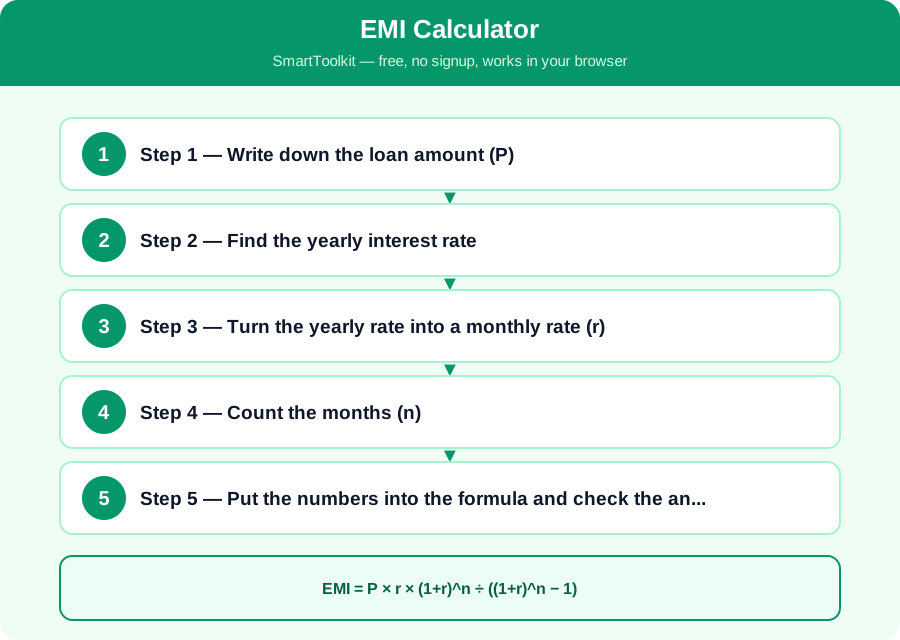
EMI = P × r × (1+r)^n ÷ ((1+r)^n − 1)
In this formula P is the loan amount, r is the monthly interest rate, and n is the number of months. To get the monthly rate, divide the yearly rate by 12 and then by 100. For a 12 percent yearly rate, the monthly rate is 1 percent, or 0.01. The part (1+r)^n grows the loan by the interest, and the division spreads the total evenly over all the months, so every EMI is the same size.
Do not confuse the yearly rate with the monthly rate. Putting 12 into the formula instead of 0.01 gives an EMI larger than the whole loan, which is clearly wrong. Also remember that n is in months, not years: a 2 year loan means n is 24, and a 20 year home loan means n is 240. Getting either of these wrong is the most common mistake in hand calculations.
How to Use the EMI Calculator — Step by Step
Follow these five steps one by one. Each step builds on the last one, so do them in order and check your answer at the end.
Step 1 — Write down the loan amount (P)
This is the money you actually receive from the bank, after any down payment. If a car costs Rs 2,000,000 and you pay Rs 500,000 yourself, the loan amount is Rs 1,500,000. Do not include the down payment, and do not include the processing fee unless the bank adds it to the loan.
Step 2 — Find the yearly interest rate
Ask the bank for the yearly rate and whether it is fixed or floating. A fixed rate never changes, so your EMI stays the same. A floating rate can go up or down with the market, so your EMI can change. Write the rate down exactly, for example 12 percent per year, and check whether the bank also charges a processing fee.
Step 3 — Turn the yearly rate into a monthly rate (r)
Divide the yearly rate by 12 and then by 100. For 12 percent a year, that is 12 divided by 12, which is 1, and 1 divided by 100, which is 0.01. This small number is the monthly rate you put into the formula. Keep at least four decimal places, because rounding it changes the EMI.
Step 4 — Count the months (n)
Multiply the loan time in years by 12. A 2 year loan is 24 months, a 5 year loan is 60 months, and a 20 year home loan is 240 months. Write n next to your P and r so you do not mix them up when you put the numbers into the formula.
Step 5 — Put the numbers into the formula and check the answer
Calculate (1+r)^n, then multiply by P and r, and divide by ((1+r)^n minus 1). For Rs 500,000 at 12 percent for 24 months, the EMI comes to about Rs 23,500. Check the answer with the free EMI Calculator on this site: if the two answers are close, your calculation is right. If they are far apart, check the monthly rate first.
Worked Example
Ayesha takes a loan of Rs 500,000 at 12 percent per year for 24 months. The monthly rate is 0.01 and n is 24. Putting these into the formula gives an EMI of about Rs 23,500 per month. Over 24 months she pays about Rs 564,000 in total, so the interest is about Rs 64,000. In the first month about Rs 5,000 of her EMI is interest and about Rs 18,500 repays the loan. In the last month only about Rs 232 is interest and the rest repays the loan. If she extends the same loan to 36 months, the EMI falls to about Rs 16,600, but the total interest rises to about Rs 98,000 — a lower EMI is not always cheaper.
Common Mistakes to Avoid
Mistake: Using the yearly rate in the formula instead of the monthly rate. This gives a wildly wrong EMI, so always divide by 12 and by 100 first.
Mistake: Comparing loans by EMI alone. A longer loan has a smaller EMI but much more total interest, so always compare the total amount you will pay, not just the monthly figure.
Mistake: Ignoring the processing fee, insurance and late charges. A loan with a low rate but high fees can cost more than a loan with a slightly higher rate and no fees, so add every charge to the total cost.
Mistake: Borrowing more than you can afford. A safe rule is that all your EMIs together should not be more than 40 to 50 percent of your monthly income. If you earn Rs 100,000 a month, keep total EMI below Rs 40,000 to Rs 50,000.
Frequently Asked Questions
What happens if I miss an EMI? The bank charges a late fee and reports the missed payment to the credit bureau. This harms your credit score and makes future loans harder and more expensive, so always pay on time or call the bank before the due date if you have a problem.
Can I reduce my EMI later? Yes, you can ask the bank to increase the loan time, but that increases total interest. A better option is usually to prepay part of the loan when you get extra money, because that cuts the interest and can shorten the loan.
Is EMI the same as interest? No. EMI includes both interest and part of the original loan amount, so the loan balance falls with every payment. Interest alone is only the cost of borrowing, and it shrinks as the loan shrinks.
Fixed or floating rate — which is better? A fixed rate is safer because your EMI never changes, which helps you plan your budget. A floating rate can be cheaper when rates fall, but it can also rise without warning. If your income is fixed, a fixed rate is usually the safer choice.
Why Use SmartToolkit for This?
You now know what EMI is, how the formula works, and how to check whether a loan fits your budget. Before you sign any loan, calculate the EMI, the total interest and the total payment, and compare at least two banks. Use the free EMI Calculator on this site to do it in seconds — it works in your browser, needs no signup and no login, and your loan details never leave your device.
Use the EMI Calculator — free, no signup, no login, and your data never leaves your browser.