How to Calculate a Loan Payment? Formula and Examples
Before you take a loan, you need to know three numbers: how much you will pay every month, how much interest you will pay in total, and how much the loan will cost you altogether. Banks show you the interest rate, but they do not always show the total cost clearly. A loan that looks cheap at 10 percent can be expensive if the time is long, and a loan with a higher rate can be cheaper if the time is short.
This guide shows you how to calculate a loan payment step by step, how to work out the total interest, and how to compare two loans fairly. It uses the same reducing balance method that banks in Pakistan use, with real examples for home, car and personal loans. The free Loan Calculator on this site does the same calculation in seconds, with no signup and no login.
What Is the Loan Calculator?
A loan payment is the fixed amount you pay every month to repay a loan. It is the same idea as EMI, and the formula is the same. Each payment has two parts: interest on the amount you still owe, and a part of the original loan. As the loan shrinks, the interest part shrinks too, so more of each payment goes to repaying the loan. At the end of the loan, the balance is zero.
The total cost of a loan is the monthly payment multiplied by the number of months. The total interest is the total cost minus the loan amount. These two numbers matter more than the interest rate alone, because they show what the loan really costs you. A Rs 1,000,000 loan at 15 percent for 5 years costs about Rs 1,430,000 in total, so the interest is about Rs 430,000 — nearly half the loan again.
The Loan Payment Formula
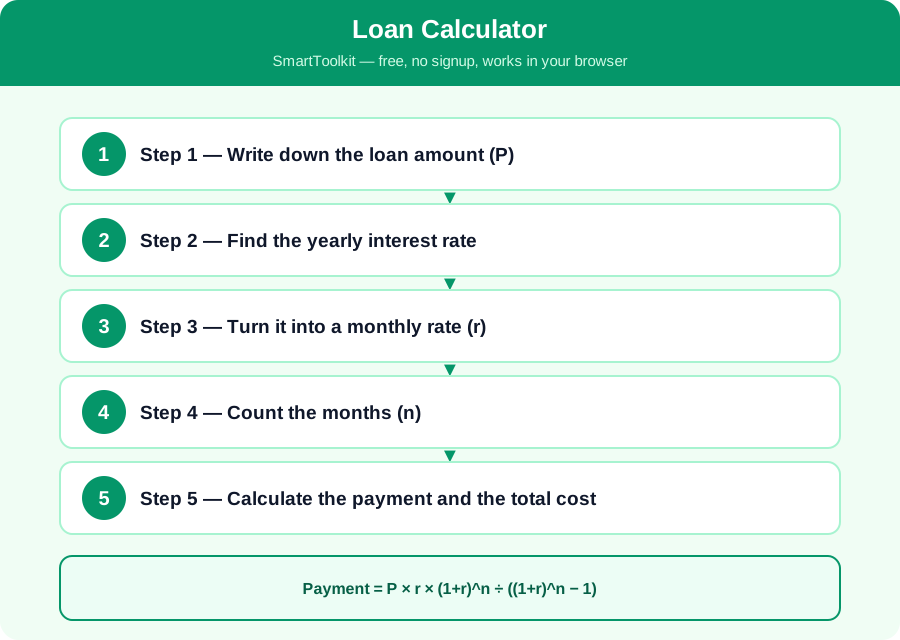
Payment = P × r × (1+r)^n ÷ ((1+r)^n − 1)
In this formula P is the loan amount, r is the monthly interest rate, and n is the number of months. To get the monthly rate, divide the yearly rate by 12 and then by 100. For a 15 percent yearly rate, the monthly rate is 1.25 percent, or 0.0125. The formula spreads the loan and the interest evenly over the months, so every payment is the same size, even though the split between interest and loan changes each month.
Do not use the yearly rate directly in the formula, and do not use years for n. If you put 15 instead of 0.0125, the payment will be larger than the whole loan, which is clearly wrong. Always convert the rate to a monthly rate and the time to months before you start, and write P, r and n down so you can check them.
How to Use the Loan Calculator — Step by Step
Follow these five steps one by one. Each step builds on the last one, so do them in order and check your answer at the end.
Step 1 — Write down the loan amount (P)
This is the money you borrow, after your down payment. If a house costs Rs 5,000,000 and you pay Rs 1,000,000 yourself, the loan is Rs 4,000,000. Do not include the down payment, and check whether the bank adds the processing fee to the loan or charges it separately.
Step 2 — Find the yearly interest rate
Ask the bank for the rate and whether it is fixed or floating. A fixed rate keeps your payment the same for the whole loan. A floating rate can rise or fall, so your payment can change. Write the rate down exactly, and ask about any other charges, such as insurance or a processing fee.
Step 3 — Turn it into a monthly rate (r)
Divide the yearly rate by 12 and then by 100. For 15 percent a year, that is 15 divided by 12, which is 1.25, and 1.25 divided by 100, which is 0.0125. This is the monthly rate for the formula. Keep four decimal places, because rounding it changes the payment.
Step 4 — Count the months (n)
Multiply the loan years by 12. A 5 year loan is 60 months, a 10 year loan is 120 months, and a 20 year home loan is 240 months. A longer loan means a smaller monthly payment but much more total interest, so think about the total cost, not just the monthly figure.
Step 5 — Calculate the payment and the total cost
Put P, r and n into the formula to get the monthly payment. Then multiply the payment by n to get the total cost, and subtract P to get the total interest. Check the answer with the free Loan Calculator on this site. If the two answers match, your calculation is right.
Worked Example
Hassan borrows Rs 1,000,000 at 15 percent per year for 5 years. The monthly rate is 0.0125 and n is 60. The monthly payment works out to about Rs 23,800. Over 60 months he pays about Rs 1,428,000 in total, so the interest is about Rs 428,000. In the first month about Rs 12,500 of his payment is interest and about Rs 11,300 repays the loan. In the last month only about Rs 294 is interest. If he takes the same loan for 10 years instead, the payment falls to about Rs 16,100, but the total interest rises to about Rs 936,000 — the smaller payment costs him more than twice as much interest.
Common Mistakes to Avoid
Mistake: Comparing loans by the monthly payment alone. A longer loan always has a smaller payment but much more total interest, so always compare the total cost and the total interest.
Mistake: Forgetting the processing fee and insurance. These can add tens of thousands of rupees to the cost, so add them to the total before you compare two loans.
Mistake: Using the yearly rate in the formula. The formula needs the monthly rate, so divide by 12 and by 100 first, or the answer will be nonsense.
Mistake: Borrowing the maximum the bank offers. The bank may offer more than you can comfortably repay, so work out the payment yourself and keep it below 40 percent of your monthly income.
Frequently Asked Questions
What is the difference between a loan payment and EMI? They are the same thing. EMI is the name used in Pakistan and India for the fixed monthly loan payment, and the formula is identical. Loan Calculator and EMI Calculator give the same answer for the same loan.
Can I pay off my loan early? Yes, most banks allow early repayment, but some charge a small fee, usually 1 to 2 percent of the amount you repay early. Check the fee first, because paying early saves interest and usually still works out cheaper even with the fee.
What happens if I miss a loan payment? The bank charges a late fee and reports the missed payment to the credit bureau, which harms your credit score. If you miss several payments, the bank can take legal action or take the asset, such as the car or house, that secures the loan.
Should I take a shorter or longer loan? A shorter loan costs less interest in total but has a higher monthly payment. A longer loan has a lower payment but costs much more interest. Choose the shortest loan whose payment you can comfortably afford each month.
Why Use SmartToolkit for This?
You now know how a loan payment is calculated, how to work out the total interest, and how to compare loans by their true cost. Never sign for a loan based on the monthly payment alone — always check the total cost first. Use the free Loan Calculator on this site to compare your options in seconds — it works in your browser, needs no signup and no login, and your loan details never leave your device.
Use the Loan Calculator — free, no signup, no login, and your data never leaves your browser.