How to Calculate Percentage? Easy Formula with Examples
Percentage is the maths you use every single day. Shops show a 20 percent discount, students get marks as a percentage, banks charge interest as a percentage, and salary increases are given as a percentage. In Pakistan and India, exam results, sale prices and tax are almost always written in percentages, so if you cannot work with them, you cannot check whether a shop or an office is giving you the right figure.
This guide explains what a percentage really means, the three formulas you need — find a percentage, find the whole, and find the change — and shows you how to use them step by step with real examples from shopping, exams and salary. The free Percentage Calculator on this site does the same sums in seconds, with no signup and no login.
What Is the Percentage Calculator?
A percentage is a number out of 100. The word comes from the Latin per centum, which means per hundred. So 25 percent means 25 out of every 100. If a class has 100 students and 25 pass, the pass percentage is 25 percent. If a shop gives 25 percent off a Rs 1,000 shirt, it takes Rs 250 off, because 25 percent of 1,000 is 250.
Percentages let you compare things of different sizes. A student who gets 80 out of 100 and a student who gets 400 out of 500 have both scored 80 percent, even though their marks look different. That is why exams, sales and interest rates all use percentages: they turn different numbers into the same scale, so you can compare them fairly and quickly.
The Three Percentage Formulas
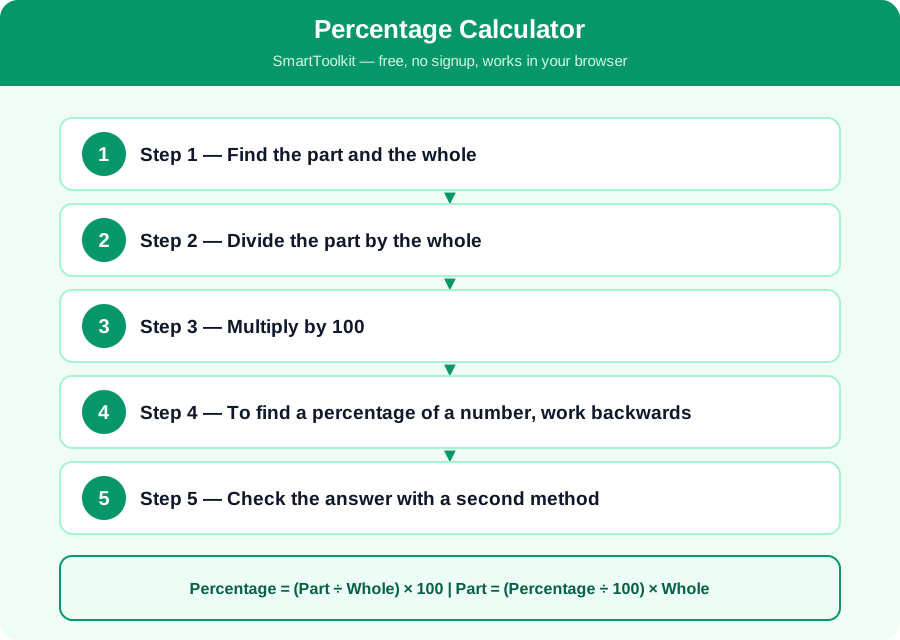
Percentage = (Part ÷ Whole) × 100 | Part = (Percentage ÷ 100) × Whole
There are three questions you will meet. First, what percentage is one number of another? Divide the part by the whole and multiply by 100. Second, what is a percentage of a number? Divide the percentage by 100 and multiply by the whole. Third, what is the percentage change? Subtract the old number from the new number, divide by the old number, and multiply by 100. A positive answer is an increase, and a negative answer is a decrease.
The most common error is using the wrong whole. If a price rises from Rs 100 to Rs 120, the increase is 20 percent, because 20 divided by the old price of 100 is 20 percent. If you divide by 120 instead, you get the wrong answer. Always ask: percentage of what? The answer to that question is the whole, and it goes under the line in the division.
How to Use the Percentage Calculator — Step by Step
Follow these five steps one by one. Each step builds on the last one, so do them in order and check your answer at the end.
Step 1 — Find the part and the whole
Write down the two numbers and label them. In a sale, the whole is the original price and the part is the discount. In an exam, the whole is the total marks and the part is the marks you got. Labelling them first stops you from dividing the wrong way round.
Step 2 — Divide the part by the whole
Do the division and keep the decimal. For 45 marks out of 60, that is 45 divided by 60, which is 0.75. If the division gives a long decimal, keep at least four places, because rounding too early changes the final percentage.
Step 3 — Multiply by 100
Multiply the decimal by 100 to turn it into a percentage. Here 0.75 times 100 is 75, so the result is 75 percent. The percent sign means the number is out of 100, so 75 percent means 75 out of every 100.
Step 4 — To find a percentage of a number, work backwards
Divide the percentage by 100 first, then multiply by the whole. For 20 percent of Rs 2,500, that is 0.20 times 2,500, which is Rs 500. That is the discount, so the sale price is Rs 2,500 minus Rs 500, which is Rs 2,000.
Step 5 — Check the answer with a second method
Check a percentage by reversing it: 75 percent of 60 should give you back 45, because 0.75 times 60 is 45. If the reverse calculation does not give your original number, you divided the wrong way round or used the wrong whole, so go back to Step 1.
Worked Example
A shop sells a jacket for Rs 4,000 and offers 25 percent off. First, 25 divided by 100 is 0.25. Multiply 0.25 by Rs 4,000 and you get a discount of Rs 1,000. The sale price is Rs 4,000 minus Rs 1,000, which is Rs 3,000. Now take a student who scores 432 marks out of 600. Divide 432 by 600 to get 0.72, multiply by 100, and the result is 72 percent. Finally, a salary rises from Rs 50,000 to Rs 55,000. The increase is Rs 5,000, divided by the old salary of Rs 50,000 is 0.10, so the increase is 10 percent.
Common Mistakes to Avoid
Mistake: Dividing the wrong way round. Always divide the part by the whole, not the whole by the part, or the answer will be more than 100 percent when it should be less.
Mistake: Forgetting to multiply by 100. A decimal of 0.75 is not 0.75 percent — it is 75 percent. The multiply by 100 step is what turns the decimal into a percentage.
Mistake: Using the new price as the whole for a change. A percentage increase is always worked out from the old number, not the new one, because the change happened to the old number.
Mistake: Adding percentages that have different wholes. A 20 percent discount followed by a 10 percent discount is not a 30 percent discount, because the second discount is taken from the already reduced price, not from the original price.
Frequently Asked Questions
How do I find 15 percent of a number quickly? Find 10 percent by moving the decimal one place left, find 5 percent by halving that, and add them. For Rs 2,000, 10 percent is Rs 200, 5 percent is Rs 100, so 15 percent is Rs 300. This works for any number.
What is the difference between percent and percentage points? If interest rises from 10 percent to 12 percent, it has risen by 2 percentage points, but the rise is 20 percent of the old rate. Percentage points are the simple difference, and percent is the difference compared with the old number.
How do I work out a percentage increase? Subtract the old number from the new number, divide the answer by the old number, and multiply by 100. A rise from 80 to 100 is 20 divided by 80, which is 25 percent.
Why do shops show percentages instead of rupees? A percentage works for every price, so one sign can cover the whole shop. A 20 percent sale means Rs 200 off a Rs 1,000 item and Rs 2,000 off a Rs 10,000 item, and the customer can work out their own saving.
Why Use SmartToolkit for This?
You now know what a percentage means, the three formulas, and how to use them for exams, shopping and salary. Percentages are simple once you always ask which number is the whole, and that one habit removes most mistakes. Use the free Percentage Calculator on this site for a fast check — it works in your browser, needs no signup and no login, and your numbers never leave your device.
Use the Percentage Calculator — free, no signup, no login, and your data never leaves your browser.