How to Calculate SIP Returns? Formula, Examples and Tips
SIP means Systematic Investment Plan. Instead of investing a large amount once, you invest a small fixed amount every month — for example Rs 5,000 a month — into a mutual fund. Over years, the monthly payments add up, and the returns on them also grow. SIP is popular in Pakistan and India because it suits a monthly salary: you invest a little from each paycheque, and you do not need a large amount to start.
This guide explains how SIP works, the formula behind it, and how to calculate your SIP returns step by step with real examples. You will learn why starting early matters, what happens when the market falls, and how to choose a monthly amount you can afford. The free SIP Calculator on this site does the same calculation in seconds, with no signup and no login.
What Is the SIP Calculator?
A SIP is a habit, not a single investment. Every month your fixed amount buys units of a mutual fund at the current price. When the market is low, your money buys more units. When the market is high, it buys fewer units. Over time this averaging smooths out the ups and downs, and it stops you from trying to guess the best day to invest, which almost nobody gets right.
SIP returns come from two things: the money you put in, and the growth of that money. If you invest Rs 5,000 a month for 10 years, you put in Rs 600,000. If the fund grows at 12 percent a year, the final value is about Rs 1,160,000 — nearly double what you put in. The extra Rs 560,000 is the return, and most of it comes in the later years, when the pot is large and compounding does the heavy work.
The SIP Formula
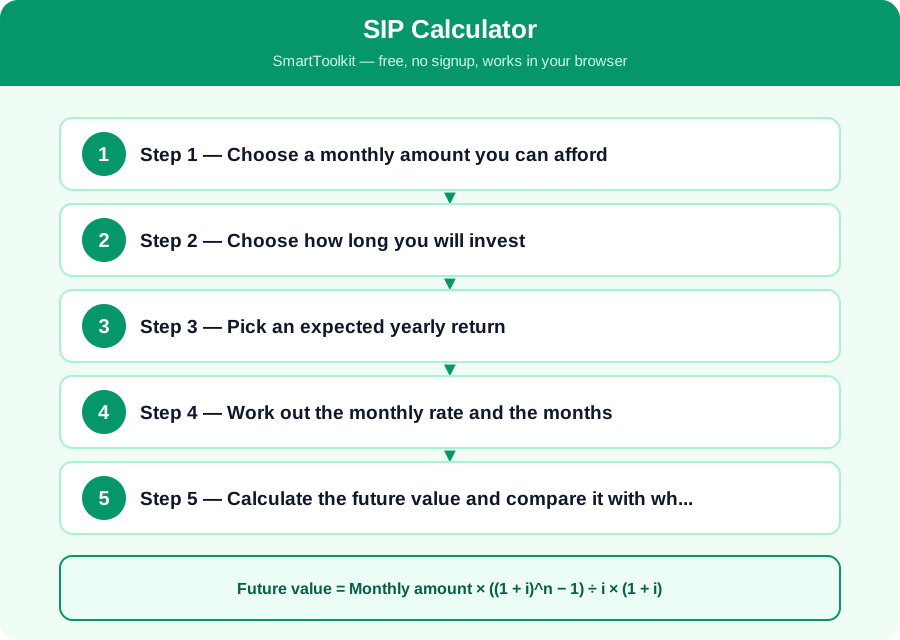
Future value = Monthly amount × ((1 + i)^n − 1) ÷ i × (1 + i)
In this formula i is the monthly return rate and n is the number of months. For a 12 percent yearly return, the monthly rate is 1 percent, or 0.01. The part ((1+i)^n minus 1) divided by i adds up the growth of every monthly payment, and the final (1+i) adds one more month of growth, because each payment is invested at the start of the month. You do not need to work this out by hand — the calculator does it — but knowing the parts helps you understand the answer.
The yearly return is an assumption, not a promise. Mutual funds do not guarantee 12 percent, and in a bad year the fund can fall. The formula shows what would happen if the fund grew steadily at that rate, so treat the answer as a plan, not a guarantee. Always check the fund's past performance and its risk level before you invest.
How to Use the SIP Calculator — Step by Step
Follow these five steps one by one. Each step builds on the last one, so do them in order and check your answer at the end.
Step 1 — Choose a monthly amount you can afford
Pick an amount you can pay every month without borrowing, for example Rs 5,000 or Rs 10,000. It should be small enough that you will not stop when money is tight, because stopping breaks the habit and loses the compounding. Start small and increase the amount when your salary rises.
Step 2 — Choose how long you will invest
SIP works best over a long time — 5, 10 or 15 years. The longer the time, the more the compounding helps. A 5 year SIP at 12 percent roughly doubles your money, while a 10 year SIP nearly doubles it again. Write down your goal and the year you need the money, such as a child's education in 10 years.
Step 3 — Pick an expected yearly return
Use a cautious number, such as 10 or 12 percent, not the best year the fund ever had. A fund that grew 20 percent one year can fall the next, so a cautious rate gives you a realistic plan. If the fund does better, you will be pleasantly surprised, not disappointed.
Step 4 — Work out the monthly rate and the months
Divide the yearly return by 12 to get the monthly rate, and multiply the years by 12 to get the months. For 12 percent over 10 years, the monthly rate is 1 percent and the months are 120. These are the numbers that go into the formula.
Step 5 — Calculate the future value and compare it with what you paid in
Put the numbers into the formula or use the free SIP Calculator on this site. For Rs 5,000 a month for 10 years at 12 percent, the future value is about Rs 1,160,000, while you paid in Rs 600,000. If the answer is below your goal, increase the monthly amount or the time, and calculate again.
Worked Example
Ahmed invests Rs 10,000 every month for 15 years at an expected return of 12 percent a year. He pays in 10,000 times 180 months, which is Rs 1,800,000. The future value works out to about Rs 4,980,000, so the return is about Rs 3,180,000 — more than the amount he paid in. If he had invested the same Rs 10,000 a month for only 5 years, he would have paid in Rs 600,000 and the value would be about Rs 820,000. The extra 10 years more than doubled the return, even though he only paid three times as much in total, because compounding had far longer to work.
Common Mistakes to Avoid
Mistake: Stopping the SIP when the market falls. A fall is when your monthly amount buys more units, so stopping at the worst time locks in the loss and misses the recovery.
Mistake: Choosing the monthly amount from a good month. Pick an amount you can pay in a bad month too, or you will stop the SIP and lose the habit.
Mistake: Expecting a fixed return. Mutual funds rise and fall, so the calculator's answer is a plan based on an assumed rate, not a promise from the fund.
Mistake: Forgetting tax and fund charges. The fund charges a small fee every year, and the profit may be taxed when you withdraw it, so the money you actually receive is less than the calculator's headline number.
Frequently Asked Questions
How much should I invest in a SIP every month? Start with an amount you will not miss, such as 10 percent of your salary. If you earn Rs 100,000 a month, Rs 10,000 is a good start. Increase it by 10 percent every year when your salary rises.
Is SIP safe? SIP is not risk-free, because mutual funds invest in shares and bonds that go up and down. Over a long time the ups and downs usually smooth out, but the value can fall in a bad year, so only invest money you will not need soon.
Can I stop my SIP any time? Yes, you can stop or pause most SIPs without a penalty, and you can usually withdraw the money, though some funds charge a small exit fee in the first year. Check the fund's rules before you start.
SIP or fixed deposit — which is better? A fixed deposit is safer and its return is fixed, but it is usually lower. A SIP can earn more over a long time, but it can also fall. Many people use both: a fixed deposit for money they need soon, and a SIP for long-term goals.
Why Use SmartToolkit for This?
You now know how SIP works, why the monthly habit matters, and how to calculate what your savings could become. Start with an amount you can afford, keep it going through good months and bad, and let time do the work. Use the free SIP Calculator on this site to plan your goal — it works in your browser, needs no signup and no login, and your amounts never leave your device.
Use the SIP Calculator — free, no signup, no login, and your data never leaves your browser.