How to Calculate Zakat? Nisab and Rate
Zakat is one of the five pillars of Islam. Every Muslim who owns wealth equal to or more than the nisab, and has owned it for one full lunar year, must pay 2.5 percent of that wealth to the poor and needy. It is not charity given when you feel like it — it is a duty, and the amount is fixed. In Pakistan, where many people keep savings in cash, gold and bank accounts, working out Zakat correctly matters every Ramadan.
This guide explains what nisab is, which assets count for Zakat and which do not, and how to calculate the amount step by step with a real example. It also covers gold and silver nisab, business goods, and the common mistakes that make people pay too much or too little. The free Zakat Calculator on this site does the same calculation in seconds, with no signup and no login.
What Is the Zakat Calculator?
Zakat is 2.5 percent of your zakatable wealth — cash in hand, money in the bank, gold and silver, and goods you bought to sell. It is not charged on the house you live in, the car you drive, your clothes, your furniture or the tools of your trade. The rate is fixed: 2.5 percent means Rs 2.50 on every Rs 100, or Rs 25,000 on Rs 1,000,000 of wealth.
Nisab is the minimum amount of wealth that makes Zakat obligatory. It is equal to 87.48 grams of gold or 612.36 grams of silver. Most scholars in Pakistan use the silver nisab because it is lower, so more people qualify — and that means more people must pay. If your zakatable wealth is below the nisab, you do not pay Zakat. If it is equal to or above it, you pay 2.5 percent on the whole amount, not just on the part above the nisab.
The Zakat Formula
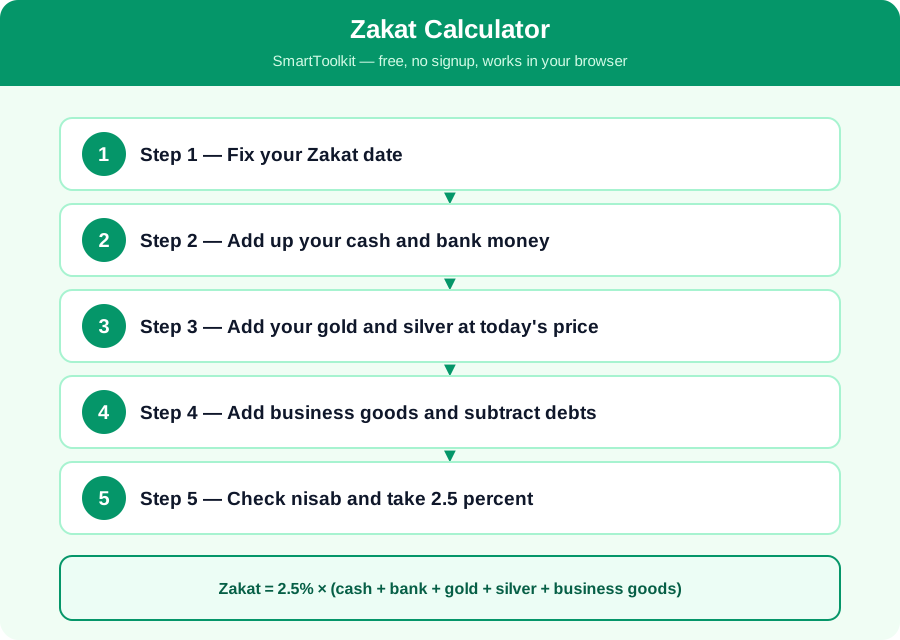
Zakat = 2.5% × (cash + bank + gold + silver + business goods)
First add up all your zakatable wealth: cash at home, money in all bank accounts, the value of your gold and silver at today's price, and the value of any goods you hold to sell. Then subtract any immediate debts you owe, such as a loan payment due this month. If the result is equal to or more than the nisab, multiply it by 0.025. That is your Zakat for the year.
Gold is valued at the current market price per gram, not at the price you paid for it years ago. If gold is Rs 20,000 per gram, 87.48 grams is about Rs 1,750,000, and that is the gold nisab. Silver is much cheaper, so the silver nisab is much lower — often around Rs 150,000 to Rs 200,000. Check the current rates on the day you calculate Zakat, because gold and silver prices change every day.
How to Use the Zakat Calculator — Step by Step
Follow these five steps one by one. Each step builds on the last one, so do them in order and check your answer at the end.
Step 1 — Fix your Zakat date
Choose one date in the Islamic year, usually in Ramadan, and use the same date every year. On that date you will check your wealth and pay Zakat. Using the same date each year makes the one-year rule easy to follow, and it stops you from paying twice or missing a year.
Step 2 — Add up your cash and bank money
Count the cash in your home, in your wallet and in every bank account, including savings accounts and fixed deposits that you can withdraw. Add them all together. Do not include money that is not yours, such as money you are holding for someone else.
Step 3 — Add your gold and silver at today's price
Weigh your gold and silver in grams and multiply by today's price per gram. Include jewellery, coins and bars. If you own gold you wear every day, scholars differ on whether it counts — many say jewellery for personal use is exempt, while others say it counts. Ask a trusted scholar if you are unsure.
Step 4 — Add business goods and subtract debts
If you run a shop or business, add the value of the goods you hold to sell, at their selling price. Then subtract any debts that are due now, such as a supplier bill or a loan instalment. Do not subtract long-term debts that are not due yet, and do not subtract your house rent for the whole year.
Step 5 — Check nisab and take 2.5 percent
Compare the total with the nisab. If it is below the nisab, you owe nothing. If it is equal to or above it, multiply the total by 0.025. That is your Zakat. Pay it as soon as you can to the people who qualify, and write the amount down so you remember it next year.
Worked Example
Bilal has Rs 300,000 in the bank, Rs 50,000 cash at home, gold worth Rs 800,000 and shop goods worth Rs 400,000. His total zakatable wealth is Rs 1,550,000. He owes a supplier Rs 50,000 due this month, so his net wealth is Rs 1,500,000. The silver nisab is about Rs 180,000, so he is well above it. His Zakat is 2.5 percent of Rs 1,500,000, which is Rs 37,500. If his wealth had been only Rs 100,000, below the nisab, he would owe nothing at all — Zakat is only due when the nisab is reached.
Common Mistakes to Avoid
Mistake: Paying Zakat on your house and car. The house you live in and the car you use are not zakatable, so including them makes you pay too much.
Mistake: Using the price you paid for gold years ago. Gold must be valued at today's price, because Zakat is on the current value of your wealth, not on what it cost in the past.
Mistake: Forgetting money in a second bank account or a fixed deposit. Add up every account, because Zakat is on all of your wealth together, not on each account separately.
Mistake: Paying Zakat before the year is complete. Zakat is due after you have owned the wealth for one full lunar year. Paying early is allowed by many scholars, but the amount should be based on the wealth on your Zakat date.
Frequently Asked Questions
What is the nisab for Zakat in 2026? The nisab is 87.48 grams of gold or 612.36 grams of silver. In rupees it depends on the current price of gold and silver, so check the rate on your Zakat date. The silver nisab is usually the lower one, and most scholars in Pakistan use it.
Do I pay Zakat on my salary? You pay Zakat on the wealth you still have on your Zakat date, not on your salary itself. If you spend your whole salary each month and save nothing, you owe nothing. If you save part of it and the savings reach nisab, you pay Zakat on the savings.
Who can receive my Zakat? Zakat goes to the poor, the needy, those in debt, travellers in difficulty, and others listed in the Quran. It cannot be given to your parents or children, because you must support them anyway, and it cannot be used to build a mosque.
Can I pay Zakat in instalments? Yes, you can pay it in parts during the year, as long as the full amount is paid. Many people pay a little each month so the amount is easier to manage, and that is acceptable.
Why Use SmartToolkit for This?
You now know what Zakat is, what nisab means, which wealth counts, and how to work out the amount step by step. Calculate your Zakat on the same date every year, and give it to the people who need it most. Use the free Zakat Calculator on this site to check your figure in seconds — it works in your browser, needs no signup and no login, and your financial details never leave your device.
Use the Zakat Calculator — free, no signup, no login, and your data never leaves your browser.