How to Convert Units? Kg to Lbs, Km to Miles, Celsius to Fahrenheit
How many kilograms is 10 pounds? How many kilometres is 5 miles? How many litres is a gallon? These questions come up every day: in cooking, in travel, in school, and in online shopping. A recipe from America uses cups and Fahrenheit, a car from Japan uses kilometres, and a parcel from England is weighed in pounds. If you cannot convert the units, you cannot follow the recipe, read the speedometer or check the parcel.
This guide explains how unit conversion works, the factors for the units you meet most often, and how to convert step by step without mistakes. It covers weight, length, temperature and volume, with real examples from Pakistan and abroad. The free Unit Converter on this site does the same conversions in seconds, with no signup and no login.
What Is the Unit Converter?
A unit is a standard amount used to measure something: a kilogram for weight, a kilometre for length, a litre for volume, and a degree Celsius for temperature. Different countries use different units, so the same amount can be written in two ways. One kilogram is about 2.2 pounds, one kilometre is about 0.62 miles, and one litre is about 0.26 US gallons. A conversion factor is the number that turns one unit into another.
Most conversions are a simple multiplication or division by the factor, but temperature is different, because Celsius and Fahrenheit start at different points. To convert Celsius to Fahrenheit you multiply by 9, divide by 5, and add 32. To convert Fahrenheit to Celsius you subtract 32, multiply by 5, and divide by 9. Getting the order wrong is the most common temperature mistake.
The Conversion Method
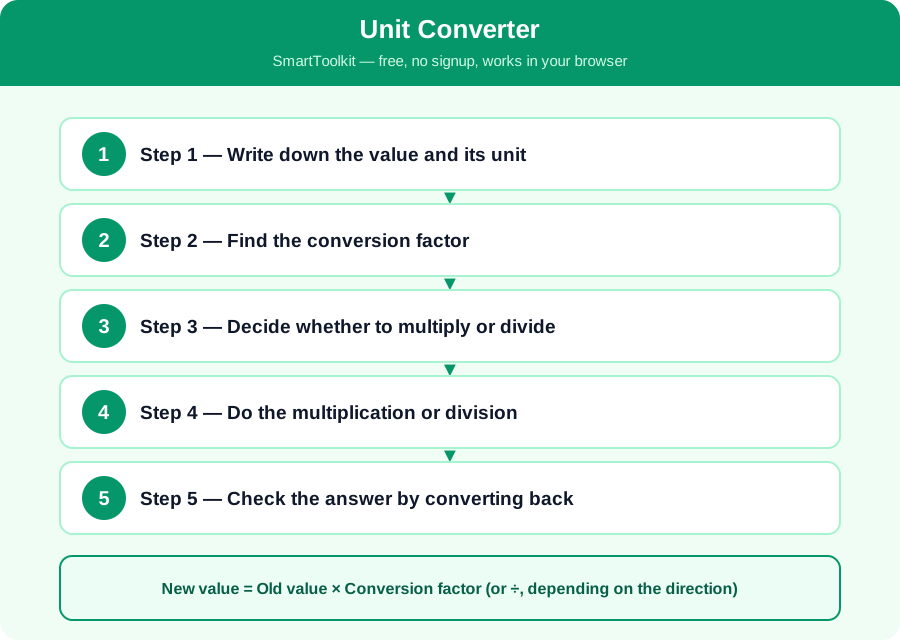
New value = Old value × Conversion factor (or ÷, depending on the direction)
To convert, multiply the value by the factor that turns the old unit into the new one. To convert 10 pounds to kilograms, multiply by 0.4536, which gives 4.54 kg. To go back, divide by the same factor, or multiply by its reverse: 4.54 kg divided by 0.4536 is 10 pounds. The factor is always written on the converter, so you do not need to memorise it, but you do need to know which way to multiply and which way to divide.
The most common error is multiplying when you should divide. If the new unit is smaller than the old one, the number gets bigger: 1 kilometre is 1,000 metres, so the number grows. If the new unit is bigger, the number gets smaller: 1,000 metres is 1 kilometre. Check the direction first: if your answer looks impossible, you probably multiplied when you should have divided.
How to Use the Unit Converter — Step by Step
Follow these five steps one by one. Each step builds on the last one, so do them in order and check your answer at the end.
Step 1 — Write down the value and its unit
Write the number and the unit it is in, for example 10 pounds, or 5 miles, or 25 degrees Celsius. Do not guess the unit — check the recipe, the sign or the label, because pounds and kilograms look the same as numbers but mean different things.
Step 2 — Find the conversion factor
Look up the factor for your two units. One pound is 0.4536 kg, one mile is 1.609 km, and one US gallon is 3.785 litres. The converter on this site shows the factor for you, so you do not need to memorise it, but write it down so you can check the calculation.
Step 3 — Decide whether to multiply or divide
If the new unit is smaller, the number gets bigger, so multiply. If the new unit is bigger, the number gets smaller, so divide. For pounds to kilograms, the kilogram is bigger, so the number gets smaller: 10 pounds becomes 4.54 kg, so you multiply by 0.4536, which is less than 1.
Step 4 — Do the multiplication or division
Multiply or divide carefully and keep at least two decimal places. For 10 pounds times 0.4536, the answer is 4.536 kg, which rounds to 4.54 kg. For temperature, follow the order: multiply, divide, then add or subtract 32, and do not skip a step.
Step 5 — Check the answer by converting back
Convert your answer back to the original unit. If 4.54 kg converts back to about 10 pounds, your answer is right. If it converts back to a different number, you multiplied when you should have divided, so go back to Step 3.
Worked Example
A recipe asks for 2 pounds of flour, and your kitchen scale only shows kilograms. Multiply 2 by 0.4536 to get 0.91 kg, so you need about 910 grams. A car travels at 60 miles per hour, and the speed limit sign says 100 kilometres per hour. Multiply 60 by 1.609 to get 96.5 km per hour, so the car is just under the limit. A cake recipe says bake at 350 degrees Fahrenheit. Subtract 32 to get 318, multiply by 5 to get 1,590, and divide by 9 to get about 177 degrees Celsius, so set your oven to 180 degrees.
Common Mistakes to Avoid
Mistake: Multiplying when you should divide. If your answer is impossibly large or small, you probably used the factor the wrong way round, so check the direction first.
Mistake: Mixing up US and UK gallons. A US gallon is 3.785 litres, but a UK gallon is 4.546 litres, so using the wrong gallon changes the answer by 20 percent.
Mistake: Forgetting the plus 32 in temperature. Celsius to Fahrenheit is multiply by 9, divide by 5, and add 32. Skipping the add 32 step gives an answer that is 32 degrees too low.
Mistake: Rounding too early. If you round the factor to 0.45 instead of 0.4536, a large conversion will be off by kilograms, so keep the full factor until the final answer.
Frequently Asked Questions
How many kg is 1 pound? One pound is 0.4536 kg, so 10 pounds is 4.54 kg and 100 pounds is 45.36 kg. To go back, divide kilograms by 0.4536, or multiply by 2.205.
How many km is 1 mile? One mile is 1.609 km, so 60 miles per hour is about 96.5 km per hour, and 100 km is about 62 miles. The speed limit of 120 km per hour is about 75 miles per hour.
What is 25 degrees Celsius in Fahrenheit? Multiply 25 by 9 to get 225, divide by 5 to get 45, and add 32 to get 77 degrees Fahrenheit. So 25 degrees Celsius, a warm day in Pakistan, is 77 degrees Fahrenheit.
How many litres is 1 gallon? One US gallon is 3.785 litres, and one UK gallon is 4.546 litres. Most fuel and cooking measurements in Pakistan use litres, so the US gallon is the one you will meet most often online.
Why Use SmartToolkit for This?
You now know how unit conversion works, the factors for the units you meet most often, and how to check your answer by converting back. The habit is simple: write the unit down, check the direction, and convert back to confirm. Use the free Unit Converter on this site for any conversion — it works in your browser, needs no signup and no login, and your numbers never leave your device.
Use the Unit Converter — free, no signup, no login, and your data never leaves your browser.