How to Calculate Salary Tax in Pakistan 2025-26?
Every salaried person in Pakistan pays income tax, and most of the time the employer cuts it from the salary before it is paid. The tax is worked out in slabs: the first part of your salary is taxed at a low rate, and the higher parts are taxed at higher rates. Because of this, your tax is not a single percentage of your salary, and a pay rise does not mean all of your salary is taxed at the higher rate.
This guide explains the salary tax slabs for the tax year 2025-26, how to calculate your tax step by step, and how to work out your take-home salary. It uses the official slab structure as an estimate, so you can check your payslip and plan your budget. The free Salary Tax Calculator on this site does the same calculation in seconds, with no signup and no login.
What Is the Salary Tax Calculator 2025-26?
Income tax on salary is charged on your annual taxable income, which is your yearly salary minus any allowed deductions. The tax is worked out slab by slab: for example, income up to Rs 600,000 a year may be taxed at 0 percent, the next part at 5 percent, the next at 15 percent, and so on, with higher slabs at 25, 30 and 35 percent. You only pay the higher rate on the part of your income that falls in that slab, not on your whole salary.
Your employer deducts the tax every month and pays it to the FBR, so the salary you receive is already after tax. The monthly deduction is your yearly tax divided by 12. At the end of the year you can file a tax return to claim a refund if too much was deducted, or to pay extra if too little was deducted. Knowing how the slabs work helps you check that your employer's deduction is correct.
The Salary Tax Method
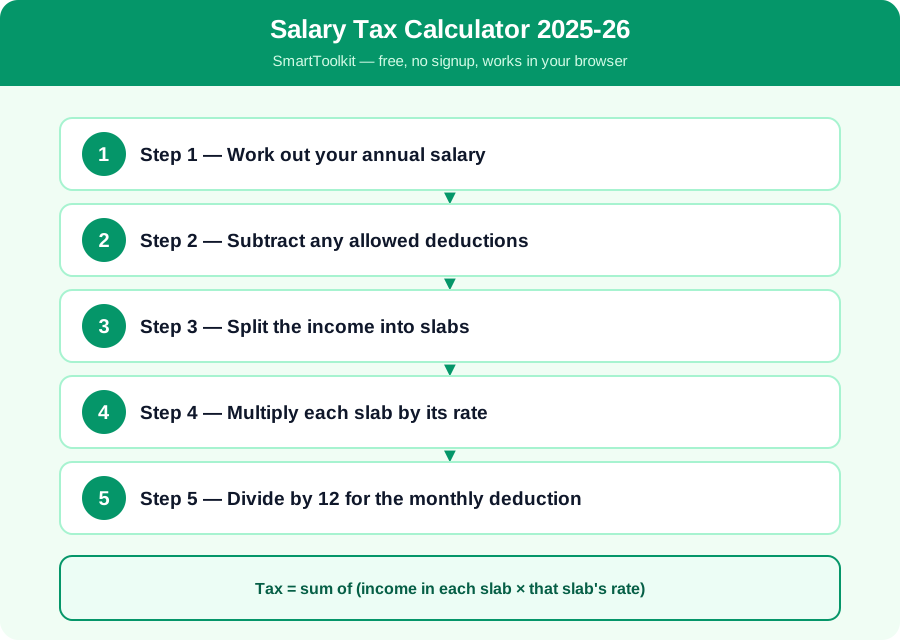
Tax = sum of (income in each slab × that slab's rate)
Split your annual salary into the slabs, multiply the amount in each slab by that slab's rate, and add the results together. For example, if the first Rs 600,000 is taxed at 0 percent, the next Rs 600,000 at 5 percent, and the next Rs 1,200,000 at 15 percent, a salary of Rs 2,400,000 a year pays 0 plus Rs 30,000 plus Rs 180,000, which is Rs 210,000 a year, or Rs 17,500 a month. The average rate is under 9 percent, even though the top slab is 15 percent.
Tax slabs and rates change in every budget, so the figures in this guide are an estimate for 2025-26 based on the slabs announced in the budget. Always check the latest FBR rates before you file your return, and remember that the calculator on this site labels its results as estimates for the same reason.
How to Use the Salary Tax Calculator 2025-26 — Step by Step
Follow these five steps one by one. Each step builds on the last one, so do them in order and check your answer at the end.
Step 1 — Work out your annual salary
Multiply your monthly gross salary by 12. If you earn Rs 150,000 a month, your annual salary is Rs 1,800,000. Use the gross salary before tax, not the amount that reaches your bank account, because the tax is worked out on the gross figure.
Step 2 — Subtract any allowed deductions
Some things reduce your taxable income, such as Zakat paid, certain allowances, or a tax credit for a home loan in some cases. Subtract these from the annual salary to get your taxable income. If you have no deductions, your taxable income is the same as your annual salary.
Step 3 — Split the income into slabs
Write the slabs down and fill them from the bottom. The first slab is taxed at the lowest rate, the next at the next rate, and so on. For a salary of Rs 1,800,000, the first Rs 600,000 goes in the 0 percent slab, the next Rs 600,000 in the 5 percent slab, and the remaining Rs 600,000 in the 15 percent slab.
Step 4 — Multiply each slab by its rate
Work out the tax for each slab separately. In the example, the first slab gives Rs 0, the second gives 5 percent of Rs 600,000, which is Rs 30,000, and the third gives 15 percent of Rs 600,000, which is Rs 90,000. Add them together: the yearly tax is Rs 120,000.
Step 5 — Divide by 12 for the monthly deduction
Divide the yearly tax by 12 to get the monthly tax. Here that is Rs 120,000 divided by 12, which is Rs 10,000 a month. Your take-home salary is Rs 150,000 minus Rs 10,000, which is Rs 140,000. Check the answer with the free Salary Tax Calculator on this site, and compare it with your payslip.
Worked Example
Fatima earns Rs 200,000 a month, so her annual salary is Rs 2,400,000. The first Rs 600,000 is taxed at 0 percent, which is Rs 0. The next Rs 600,000 is taxed at 5 percent, which is Rs 30,000. The remaining Rs 1,200,000 is taxed at 15 percent, which is Rs 180,000. Her total yearly tax is Rs 210,000, or Rs 17,500 a month, and her take-home salary is Rs 182,500 a month. If her salary rises to Rs 250,000 a month, only the extra Rs 600,000 a year is taxed at the higher rate, so her tax rises by Rs 90,000 a year — the rest of her salary is still taxed at the lower rates.
Common Mistakes to Avoid
Mistake: Applying the top rate to the whole salary. Only the part of your income in the top slab is taxed at the top rate, so using that rate on the whole salary gives a tax figure that is far too high.
Mistake: Using the monthly salary in the slab table. The slabs are annual, so always multiply your monthly salary by 12 first, or the answer will be completely wrong.
Mistake: Forgetting that the employer already deducts the tax. The salary in your bank account is after tax, so do not pay the same tax again when you file your return.
Mistake: Using last year's slabs. Rates and slab limits change in every budget, so always use the current year's slabs, and treat any calculator result as an estimate until the FBR confirms the rates.
Frequently Asked Questions
Do I pay tax if my salary is Rs 50,000 a month? Your annual salary is Rs 600,000, which is usually within the tax-free slab, so your income tax is zero or very small. Your employer may still deduct a small amount, which you can claim back when you file your return.
What is the difference between gross and net salary? Gross salary is your full salary before tax and other deductions. Net salary, or take-home salary, is what reaches your bank account after tax and deductions. The tax is always worked out on the gross salary.
Can I get a tax refund? Yes. If your employer deducted more tax than you actually owe, you can claim the extra back by filing a tax return with the FBR. Keep your payslips and tax deduction certificates, because you will need them.
Is my bonus taxed too? Yes. A bonus is part of your income, so it is added to your annual salary and taxed at the slab rate that applies to it. Many employers deduct the tax from the bonus itself, so the bonus you receive is already after tax.
Why Use SmartToolkit for This?
You now know how salary tax slabs work, how to calculate your tax step by step, and how to work out your take-home salary. Check your payslip against this method every few months, and keep your tax documents safe for your annual return. Use the free Salary Tax Calculator on this site for a quick estimate — it works in your browser, needs no signup and no login, and your salary details never leave your device.
Use the Salary Tax Calculator 2025-26 — free, no signup, no login, and your data never leaves your browser.